

What comes after AI literacy?
Notes from a keynote in Tauranga, and the business session I stayed for afterwards

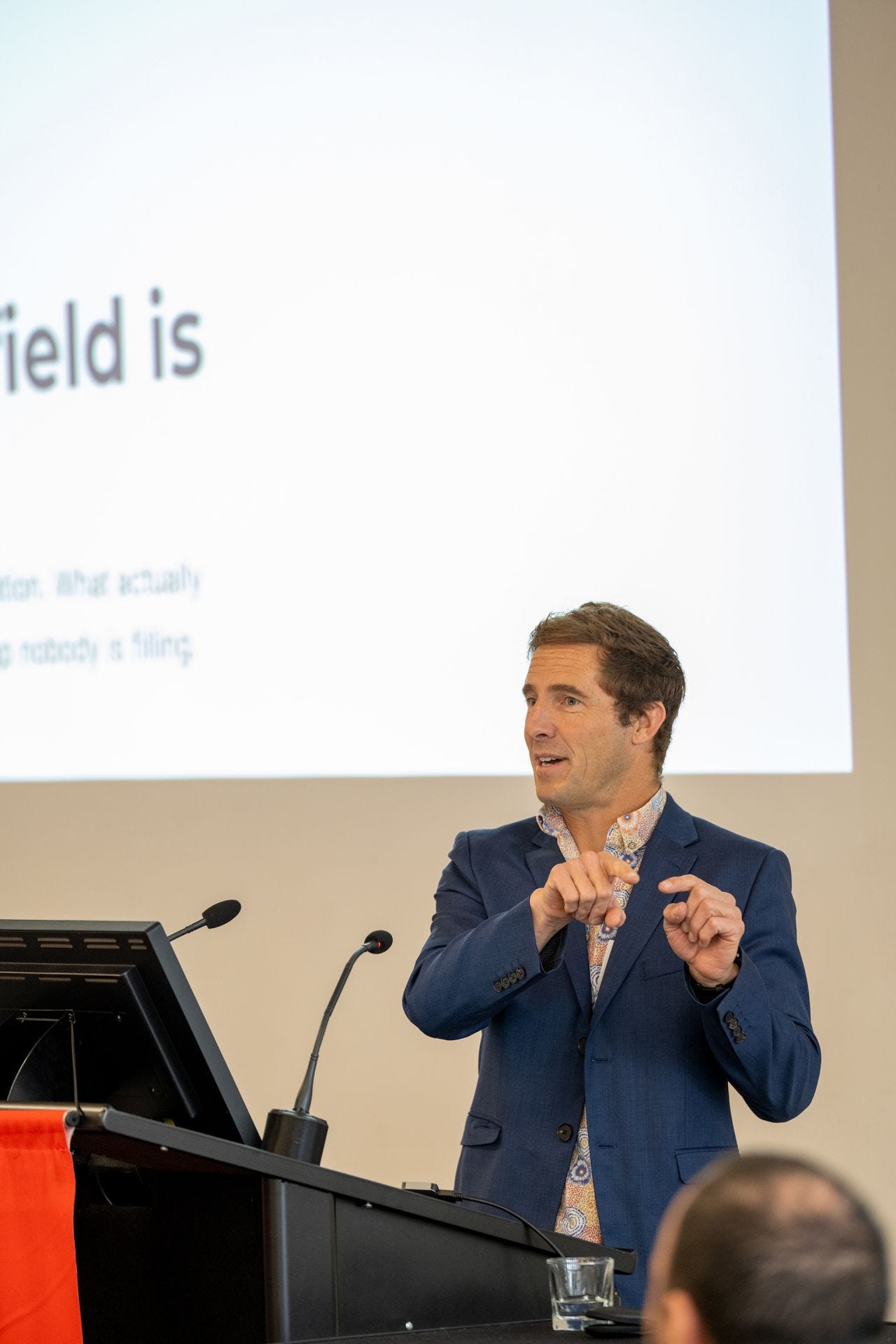
Recently I was the keynote speaker at the Tauranga Innovation in Education Summit. I opened the talk with a question: how many people in the room had found their way there without using a map (not your classic paper topo map or the A-Z you used to keep under the passenger seat, the online one that everyone has on their phones). Not many hands went up. Though it seemed like a minor, throwaway comment from an ex-geography teacher, it actually set the stage for the ideas I wanted to unpack during the rest of the talk. A paper map makes you pay attention: working out where you are, noticing your surroundings, appreciating the journey as you go rather than just the destination. GPS quietly does all of that for you. You still arrive, but you’ve skipped the part where you actually build an understanding of how you got there.
The title of the talk was: what comes after AI literacy? It built on the keynote from the previous year, when Professor Kathryn MacCallum introduced the SAIL framework, first published in He Rourou and now, more fully, in Computers and Education.
From there the talk moved through the last few years of what we’ve actually seen here: the panic of 2023, when ChatGPT arrived and schools scrambled for blanket bans (or blanket enthusiasm); the policy scramble of 2024, when every system produced a framework and most of them aged quickly; and where we are now, with AI sitting in many teachers’ workflows (around 80%, according to the NZCER Primary School AI Research), the emergency atmosphere largely gone, but the harder questions still largely unresolved.

Drawing on three years of work with the AiEdCoP (which crossed 600+ members around the time of the keynote, up from two people having a conversation in 2023), I laid out what the evidence actually shows about AI and learning. Three research findings sat at the centre of the talk, and they point in different directions.
The first one was from Bastani et al., 2025: students using AI scored 48% better before an exam but 17% worse during it. Something happens between the preparation and the performance. A second study from Fan et al., 2025 named what might be going on: “metacognitive laziness,” where students produce work that looks impressive but haven’t built the understanding underneath it. They’ve borrowed the scaffolding without doing the construction.
The third finding pointed somewhere more hopeful, and it came from Sierra Leone. A study there reversed the usual dynamic: instead of AI answering students’ questions, it asked them questions. Learning gains of 1.2 to 1.8 years were recorded over eight weeks. That’s a remarkable result, and it suggests the direction of use matters more than the fact of use.
I also shared some emerging findings from some research that I have been working on with colleagues from the University of Waikato and Massey University - the focus was on how AI had been used in assessment. Of 277 students in the study, 152 chose not to use AI in their assessments. Most of them weren’t confused or short of resources. They were making a deliberate choice. They wanted the work to be their own. I framed that in the talk not as a problem to fix but as a signal worth paying attention to.
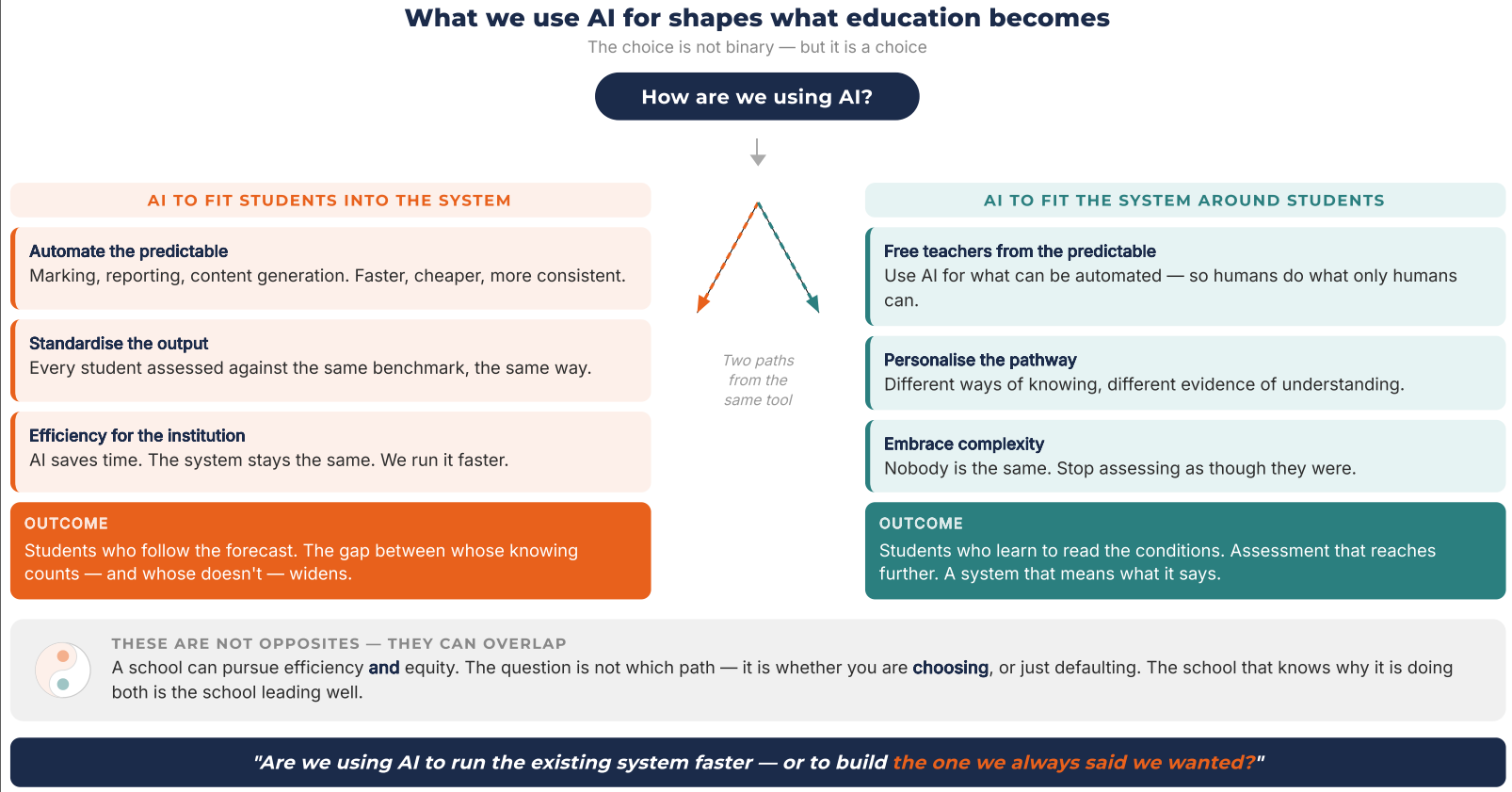
The keynote closed with a challenge: AI literacy matters, but it isn’t the destination. The real question is what it means to learn well, live well, and be well in a world shaped by AI. And the choice isn’t between efficiency and equity - it’s whether we’re making that choice consciously, or simply going along with the current.
Richard, who organised the event, invited me to stay for the Tauranga AI Business Summit that afternoon - and the room felt different from the one I'd just left.
In the morning, the questions in the room and the sessions that I went to had been about data protection, the integrity of learning, how to support young people in understanding what these tools actually do, and what it might mean for their futures. Those aren’t small questions. They’re the kind of questions you ask when you feel some responsibility for the people on the receiving end.
In the afternoon, those questions didn’t appear. What appeared instead was a different frame entirely. The starting point wasn’t “should we use these tools?” or even “how might we use them carefully?” It was: given that we’re using them, how do we use them to maximise profit, efficiency, and the effectiveness of our business? The questions about what AI is doing to customer relationships, to environmental cost, to data sovereignty - they simply weren’t part of the conversation.
The “if you don’t, you’ll be left behind” narrative was in the room, the way it usually is in these discussions. It skips over the kind of reflection that might lead somewhere more considered, and nobody in the room pushed back on it. No one asked whether the race was worth running, or who got to decide the direction. That’s the same point the Sierra Leone study made: direction of use matters more than the fact of use. The business room had already settled the fact of it. It never got near the direction.
That’s not bad faith. Businesses have real obligations, and competitive pressure is genuine. But sitting there, I thought about the educators I’d been with that morning - working out what’s right for learners, asking uncomfortable questions of their own practice, building a body of evidence rather than assuming the answer. That’s the gap: a sense that the people most affected - students, young people, children - have an interest in how this goes, and deserve to have that interest taken seriously.
What the day left me with isn’t a clean conclusion. But it matters that educators are asking these questions, even when it’s awkward, even when the pressure is to just get on with it. It’s been a slow road to understanding how AI might affect teaching and learning, and there are things we need to get right before we go down the route of using AI simply to fit students more efficiently into the system. Students could be framed as end-users, or customers, in that system. But a neo-liberal, transactional education system doesn’t sit well with young people whose main job is still to learn, not to produce. When educators are pressured to demonstrate ROI, the temptation is to let students use the tools to hit the grade rather than do the learning: exactly the kind of shortcut Fan and colleagues warned about in their “metacognitive laziness” research, except this time it’s the system doing the offloading, not the student.
There’s real joy in learning for its own sake, in embracing the struggle rather than shortcutting around it, and that’s worth protecting regardless of which tools are on the desk. The harder version of “AI literacy” isn’t learning to use the tools. It’s being deliberate about why you’re using them, and for whom.
If you were at TIES and want to follow up, all the resources from the morning session are at tauranga.futurelearning.nz - slides, transcript, and the research behind the talk. The AiEdCoP community is where this kind of conversation keeps going, and it’s free to join. And I’d love to hear from anyone who was in both rooms, or is across both business and education - whether the contrast landed the same way for you, or differently.
This post was written by me. ContentedAI transcribed the keynote recording, and I used a critical version of Claude to work through a draft. The thinking is mine.
References
Coblentz, D., Dong, J., & Gibbs, B. (2025). Generative artificial intelligence in Aotearoa New Zealand primary schools—Teacher and student survey findings. New Zealand Council for Educational Research. https://www.nzcer.org.nz/research/publications/generative-artificial-intelligence-aotearoa-new-zealand-primary-schools
Fan, Y., Tang, L., Le, H., Shen, K., Tan, S., Zhao, Y., & Gašević, D. (2025). Beware of metacognitive laziness: Effects of generative artificial intelligence on learning motivation, processes, and performance. British Journal of Educational Technology, 56(2), 489–530. https://doi.org/10.1111/bjet.13544
Gander, T., & Shaw, B. (2024). AI in education 2023: Understanding the impact on effective pedagogy, inclusive learning and equitable outcomes in Aotearoa. He Rourou, 1(1). https://doi.org/10.54474/herourou.v1i1.9137
Gander, T., & Shaw, B. (2024). Navigating the AI landscape: New Zealand educators’ perspectives. EdMedia + Innovate Learning 2024. https://www.learntechlib.org/primary/p/224426/
Ghahramani, Z. (2026, June 9). Measuring the impact of learning with AI in Sierra Leone and beyond. Google DeepMind. https://deepmind.google/blog/measuring-the-impact-of-learning-with-ai-in-sierra-leone-and-beyond/
Heimans, S., Biesta, G., Takayama, K., & Kettle, M. (2023). ChatGPT, subjectification, and the purposes and politics of teacher education and its scholarship. Asia-Pacific Journal of Teacher Education, 51(2), 105–112. https://doi.org/10.1080/1359866x.2023.2189368
MacCallum, K., Parsons, D., & Mohaghegh, M. (2026). The Scaffolded AI literacy (SAIL) framework: Results of a Delphi study for equitable AI literacy framework design in education. Computers and Education: Artificial Intelligence, 10, 100584. https://doi.org/10.1016/j.caeai.2026.100584